Monday, August 20, 2012

Weekend trip to Diablo anchorage

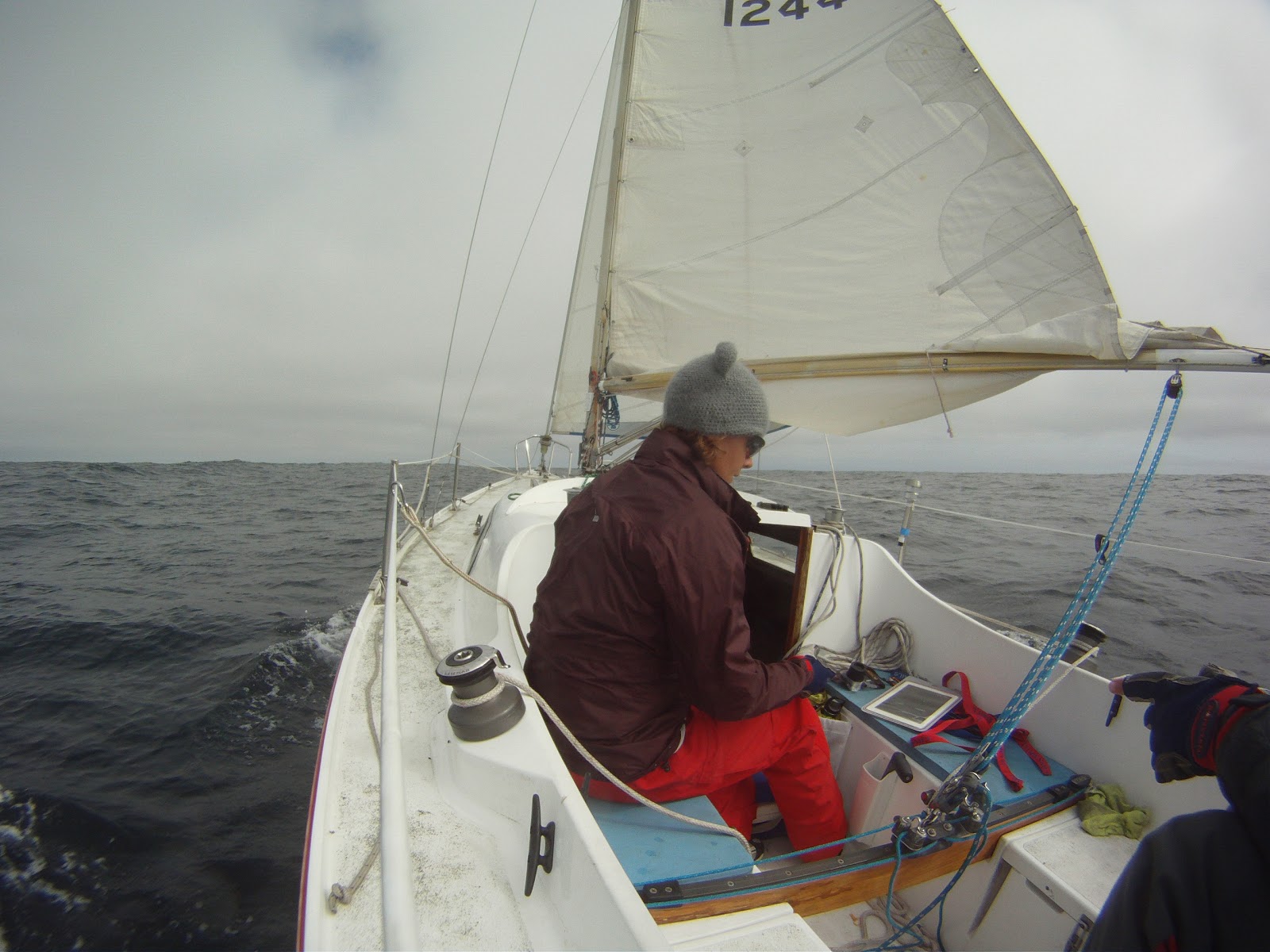
This weekend Kitty and I went for a short trip to Santa Cruz Island and back. The forecast had been for  not a lot of wind, so we had planned to arrive at the west end of the island, then sail east along the coast checking out the various anchorages. I was hoping to anchor at Lady's cove. It turned out that there was actually quite a lot of wind once we got within 5 miles of the island, probably close to 18 kts with 4 ft swells. We made landfall a bit east of the west end, then sailed wing-on-wing, past Cueva Valdez, which only had one boat, to Lady's, which was occupied by two large sailboats and a fishing boat, leaving no room for us. So we continued east to Diablo anchorage, which only had one other small boat anchored at one end, and stayed there.

On the first part of the sail to the island we only had about 10 kts of wind, so Kitty took the opportunity to test her aerial photography kite. The kite looks like this:

and then she added the camera on a rotating base, which looks like this:
We got lots of photos of the surface of the ocean, and a few cool ones of Koan, like these:


The anchoring was uneventful, and we had a very nice dinner. Unfortunately there was a lot of surge in the anchorage, and I didn't sleep very well in the rolling boat. But I woke up happy that we had not had any anchor alarms during the night.

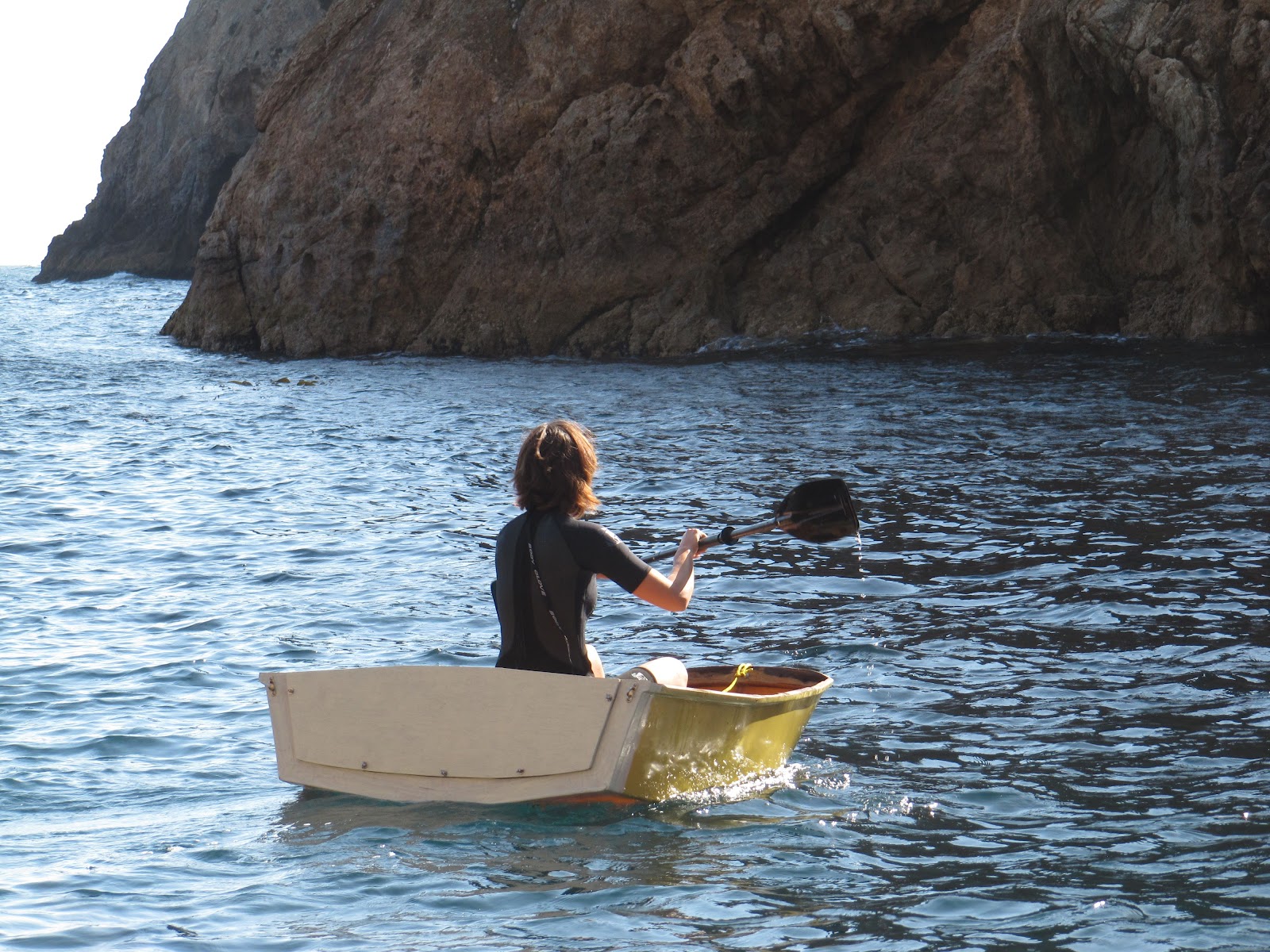
The Sunday morning project was to test the launching of the dinghy from the foredeck. That wasn't a problem, and I paddled it around the cove to make sure it didn't take on any water.


I took some photos of Koan anchored:


Then Kitty took over the dinghy and I went snorkeling, and out on the beach to explore it, and to meet our neighbors:

After we dried off, we read a little, and then, when the wind really picked up (because we like maximum difficulty) we planned our de-anchoring and exit. We had lots of wind on the way back, so we kept the main reefed most of the time and still made 7 kts over ground. We made it back in 4 hrs, which is my personal best record so far!

Tuesday, July 10, 2012

Another fantastic sailing movie

I've previously posted about "Hold Fast", one of my favorite sailing movies of all time. Well, it's time to add another much anticipated release to the list! I followed Nick Jaffe's trip across the Atlantic and the Pacific through his website BigOceans, and actually learned a lot in the process. Now Jack Rath has made a documentary called "Between Home", which you can download here, from Nick's footage before and during his passages. I watched it the other night and I loved it. I thought it was honest and beautifully shot, and really those were the two things I was looking for. It's not prettified and it's not what I would call a happy ending, or a happy anything, really, movie. It was true to the sense I've gotten from reading the writings of and chatting with other people who've pulled off similar things. Highly recommended!

Monday, July 2, 2012

The custom dinghy


I've wanted a hard dinghy that's small enough to fit on Koan's foredeck, and big enough to carry one or both of us and the dog from the boat to shore when we're out at the islands. When someone posted a free Naples Sabot on craigslist, I jumped at the opportunity. The Sabot is 8 ft long, and we only have about 6 feet of length on the foredeck, before the dinghy starts to interfere with the anchor cleat. In addition, the cabin is in the way, and the dinghy can't lie flat. I didn't like the idea of it sitting on top of the cabin top, because it's difficult to stabilize it by tying it down, and it's also very high, with a lot of windage. So the obvious solution to all our problems was to shorten the dinghy and build a custom transom that fits around the cabin top. 

I used 3/8'' ACX plywood, which I screwed in at three places, and two layers of fiberglass tape. Then I painted everything, and made an overlapping transom piece that screws in with 5 bolts, tightening around a thin rubber strip to make it water tight. 

It seems to work!

Sunday, May 13, 2012

Wednesday, April 4, 2012

Time lapse videos from the trip

During our recent sailing trip to Santa Cruz Island we had the use of Dan's Hero HD camera with a waterproof enclosure, so we took some time lapse photography series. The settings were for 720p every 30 seconds, and I compiled them at 1 frame per second at lower resolution.

The first time lapse is of our first morning at anchor. We're having breakfast and doodling around. The water's too cold to go snorkeling, so we're kind of boat-bound. I think that in these circumstances the boat is very much like a super comfy portaledge.


The second time lapse is of us motoring towards our next anchorage that afternoon. The island is to our left and we're checking out all the cool caves we're motoring by. A bit after the battery ran out things got interesting, as the wind kicked up right on our nose.


The third is of us sailing away from the island the day after, but after all the excitement of putting away the anchors and sailing through the windiest bit is done for. At some point in this time lapse we shake out the reef in the sail, as the wind drops, then switch to motoring when the wind dies completely.


The final video is on that same leg, when the wind comes back up, from the opposite direction, when we're about 5 miles offshore of Santa Barbara. At this point we have water or some other kind of gunk on the camera's enclosure, so the view is a little blurry.


This was my first experiment with time lapse, and I had a lot of fun. It saves battery power compared to video (i.e. you can get a longer time lapse series than you can shoot continuous video on the same amount of battery power) and it's better at showing the motion of the boat through the seascape around it. Since the Hero is mounted on a fixed point in the boat you lose all sense of the boat's side-to-side motion, which is considerable, but you can get that back by focusing on any object on the boat that's hanging, e.g. the gloves or a mug on the lifelines, or a line off the spreaders in the first video. Of course, unlike in video, there is no sound. I could've stuck a sound track on these, but I wanted to try them out on you raw first. What do you think? What stands out? Does it look like what you thought things would look like on a small boat?

Tuesday, April 3, 2012

Gear abuse

Because this was the Origo stove's first trip, I wanted to have a backup stove in case that didn't work. Also I was imagining an outside stove and an inside stove situation, so that if we felt like hanging out in the cockpit we wouldn't have to, you know, commute five feet into the cabin to check if the water's boiling. I don't know, explain it however you like! I was just over-prepared, as usual.

So I brought along my beloved pocket rocket, plus a hanging kit for a jetboil that I found on sale at some point. The hanging kit doesn't work properly for the pocket rocket, but, well, we're equipped with all sorts of fun things on board, including fancy $10/roll Monel bailing wire, essentially. So I wired the stove to the hanging bracket. The plan was to suspend it from the backstay like so:

So I did and I put a pot of water on it, and lit it and let it do its thing, until the pot came crashing down, and when I looked up at the stove I found that the skeleton had bent.
I think the way I suspended it had the skeleton a bit too close to the flame, and as it warmed up it became softer and it eventually warped. The good news is that I'm so strrrrong that I was able to bend it all back into shape. For what? The next experiment in gear abuse, I'm sure.

Thumbs up gear

Some of the new gear on the trip proved to be worth their weight in gold.


For example, the Origo 1500, equipped with potholders and sitting in a custom cabinet that I built for it, was a smashing success. People had warned me that alcohol stoves burn too cool and too sooty, propane is better, etc etc. Aside from filling the alcohol canister from a jerry can of alcohol, which was difficult and wasteful, we had no problems with the stove. We used a long-nosed lighter to start it, and it started and ran reliably, quietly and effectively. We had one $25 aluminum pressure cooker and a $10 aluminum percolator kettle, minus the percolator. The pressure cooker fit with the pot holders at max and the kettle with the pot holders at the minimum of their expansion range. Both worked beautifully, and we had no hesitation using the stove whenever we needed it -- partly a safety concern in a cold environment.

We had no problem using the iPad in all conditions with
the CaseLogic case.
One of our tech toys, the CaseLogic water resistant iPad case, got put through its paces and worked really well. Aside from paper charts, we wanted to use the iPad with iSailGPS to automatically plot our location on scanned charts. This setup worked really really well. The iPad acquires a satellite signal faster than any other GPS I've ever used, so it was really easy to pull it up to the cockpit and do our work on it without worrying about how much spray we had coming in at the time. The touch screen works well right through the case and the clarity is quite good. As a bonus, the case protects the iPad from scratches and also pads it a little, for when it gets knocked around.

Finally, we only had one chance to use the GoalZero Nomad 7 solar panel to charge the Hero HD's camera, and that was in cloudy conditions. The charging light stayed on, and indeed the battery got some charge, but we had low expectations in those conditions and we didn't log how long we charged it or how far it charged.