Monday, January 5, 2015

Moss Landing at last

In mid-July Kitty and I completed Koan's move to Moss Landing. The trip up was stunning. We encountered lots of whales in San Simeon Bay, South of Point Piedras Blancas, and motored along that stretch enjoying the show.


Point P.B. still had more breeze than forecast, around 11 kts on the nose, but the sea state was manageable this time, so we pushed on. I will never get over the psychological imprint of that spot. It's truly a minor Mordor in my mind.


We passed it just before sunset and switched to taking night watches. There was a long swell running, but everything else was straight forward. I had an especially surreal watch around midnight, during which the fog broke for a few miles and I was treated to the most breathtaking sky. The milky way looked like hot coals, I shit you not. Then the moon rose over the mountains behind Big Sur. It looked huge and it was the color of a blood orange. I actually spent a few seconds staring at it trying to figure out what it was. I dragged Kitty out of bed to show it to her, but she wasn't as impressed (so sorry!).

Dawn came upon us just before Pt Sur, so we got to see that when we crossed it. We kept on motoring and things got interesting as we approached the Monterey headland, which has a huge kelp bed offshore. The wildlife started to multiply, and pretty soon we noticed what looked like explosions in the water. It turned out the Monterey Bay was experiencing a sardine hatch, and humpbacks had come in to feed. Watching the humpbacks do their thing while traversing the Bay was absolutely the coolest thing ever.

Moss Landing Harbor is in an estuary, so the sardine density was especially high at its outlet, and so was the whale density. It sounds crazy, but the situation was so jaw-dropping that we didn't get any photos. There were whales breaching right and left of us, within 100 yards. I kept thinking that they outweigh the boat by, oh, 50x, maybe 100x? If one were to hit us, we'd be goners. And on top of that, I wasn't quite sure how to observe the "do not harass whales" law which requires me to shut off my engine when within X feet (can't remember how many) when I obviously needed to go right through their midst to enter the harbor. So we plugged on, and kept our eyes open and just soaked it all up.

Neither of us had ever been to Moss Landing before, but we had no trouble finding the guest dock and the harbor master and arranging a slip. I think I might have slightly scared the guy though, as I walked in, reeling from 24 hours on a pitching boat, hair all crazy, wearing foulies, and a bit giddy from dodging whales.

And there Koan stayed for the next 4 months. Kitty and I paid her frequent visits, Jim and I took her out on a whale watching trip, Dan and Hucks came up and explored the area, and I generally fell in love with Moss Landing.


And then in December I passed Koan on to her excited new owner. I know she'll take good care of him and vice versa.

Let's see where the breeze takes me next...

Tuesday, July 8, 2014

Uphill migration leg #2 attempt #1

On Saturday Kitty and took off from Morro Bay to try to sail up to Monterey. The small craft advisory had been lifted for exactly one day, and we figured we may as well make a run for it. We left the harbor at noon, and saw lots of whales and scared lots of birds as we crossed Estero Bay. Probably the highlight was coming very close to a pair of what we thought were gray whales, a big ol' one with a munched up tail, and a smaller one with a perfectly shaped tail. In fact, the tails looked so different that we're now wondering whether they were two different kinds of whales. Later on we saw a pair of pilot whales, as well. We crossed Pt Estero and started running into steepening swells. The motor started cavitating every once in a while and the boat would also go into crazy rolls without the main up. So we put up the main and soldiered on. We passed some incredible seaside mansion complexes south of Cambria, and saw some kind of brutalist/cubist probably military installation up on the hill above town. The more we made our way towards Pt Piedras Blancas, the stronger the breeze got, and the steeper the waves. Eventually the motor started to cavitate a lot, and our speed dropped to 3.5 kts at our usual RPM. I decreased the RPMs on the motor to try to help it out, but then our speed dropped to 2.5 kts. Things were getting pretty miserable, with 13-14 kts on the nose, and making only 2.5 kts progress, so we decided we may as well sail. Under full sail, hard on the wind we made ~4 kts SOG and 2+ kts VMG, so really there was no disadvantage there. We took one big tack in just N of San Simeon, then a big tack to a point about 3nm S and 2nm offshore of Piedras Blancas. At that point the swell got really steep and square, and, while struggling to keep the point at max VMG, I dropped it off a couple waves. The shudder was kind of terrifying, and I figured, if we're going to lose the rig, one of these drops will probably do it. We tacked back, aiming to pass just N of PB, and Kitty took the helm. I went below to check on the windalert.com measurement for PB, and smelled intense gasoline smell. We don't keep any gasoline in the cabin, so the smell had to be diffusing in from the lazarette. When I looked in there I found the almost-empty tank, being light, had completely upturned during one of those falling-off-a-wave moments, and was draining into the lazarette, and the fuel hose to the motor had also disconnected from it, voiding its contents. Luckily there was only a quarter cup of gas sloshing around, and I was able to clean it up right quick, but the whole thing was disturbing. Around the same time, it dawned on me that at 2 kts VMG we weren't going to make it to Monterey by Sunday night, and, under the best circumstances, I figured we still had a lot of sailing before finding conditions flat enough to motor in. So a bit S of PB, we turned our nose downwind and started heading back to Morro Bay. We had an exhilarating run, while watching a gorgeous sunset, ate some munchies, and a couple hours later switched back to motoring, once our sailing speed dropped below 3.5 kts. Kitty went below for a quick nap, and I managed to drive the boat into a kelp in the pitch dark, since I wasn't following my outbound track. We pulled up the motor, slowly motored out to our kelp-free outbound track, and re-engaged the motor. Halfway across Estero Bay, around midnight, the night dolphins showed up to keep us company. I was feeling our mortality very acutely, in the pitch black, very foggy, very wet night, and the dolphins helped somewhat to cheer me up. There were half a dozen of them, doing their usual tricks, looking like torpedos, with their cylindrical phosphorescence trails. At one point Kitty told me to stick my head in the cabin, and I heard their clicking sonar, which is how they knew where we were, and never touched us. They're incredible. We got near the entrance of Morro Bay around 1:30am, and realized we could neither hear the fog whistle buoy, nor see the entrance buoy. Thank goodness for GPS, because the situation was completely hopeless. Kitty engaged super-navigator mode, and I took over from Otto as the helmsperson. Eventually we spied the entrance buoy, but keeping it ahead was a real ordeal, as it would appear at 20 degrees up from what I thought was the horizon for one blink, then 20 degrees below my horizon for the next blink, 4 seconds later. We were running some biiiig swells, in the middle of the night, in the soupy fog. Eventually we spied the glow of the breakwater light, and made for that, and then we looked for red can after red can, and followed them in. I counted that we used 4 separate GPS mapping things: Kitty's Garmin, iSailGPS, iSailor, and finally Google Maps to figure out which dock belonged to the yacht club. Eventually we pulled up to the dock, and we to sleep already. So... Koan's still in Morro Bay. And we've learned that we need to lash gas tanks, follow kelp-free tanks, and allow twice as much time if there's a chance we can't motor during an upwind journey. Phew!

Thursday, June 12, 2014

Uphill migration -- leg #1

Koan has begun her trek North. Motivated by NWS LOX's promise of glassy seas and complete lack of breeze, we made a mid-week bum rush W-NW towards Morro Bay. After a morning of hauling gas cans until my shoulders burned, and at least 4 copies of the same checklist floating around on the kitchen table, Kitty and I departed on time, noon sharp on Tuesday. Not a minute too soon, as Harbor Patrol would have been there to kick us out for slip fee non-payment if we'd stayed a minute longer!


We motored the whole way, at probably 2/3 throttle on our little Honda 5 hp, and did chores and generally got the boat ready for the night passage. We had some breeze, probably around 10 kts, in the mid-afternoon, then everything quieted down as we approached Point Conception. We rounded at 7:45pm, and continued on a straight line to Pt. Arguello. Half-way between the two we noticed what seemed like an unusually high concentration of boats (2!) around what looked to me like a workboat mooring. We turned on the VHF as we were passing abreast, only to be greeted by a Coast Guard notice to mariners informing us that what we were witnessing was in fact a barge in the process of sinking. Too cool! Kitty claims it changed shape as we went by. I'm not so sure, but in any case, very interesting. And *no* mention of it anywhere in the CG news today...


It got dark shortly after that, and we found ourselves wondering what was causing the eerie glow behind Pt Arguello. As we rounded we were treated to the otherworldly view of a Vandenberg vehicle assembly building fully lit up, with a perimeter of extremely bright lights, in the fog. As we rounded the point we had some, ahem, navigational doubts, so we switched to waypoint (instead of eyeball) navigation for the night. We left platform Irene to port, and then everything was completely dark. Our biggest worry was the possibility of snagging a crab pot and burning the engine or mangling the prop in the process, but we seemed to miss the ones we came to see by a good 10 feet every time. We eventually had dinner and switched to our night-time tethered-to-jacklines-when-on-deck system. We started 2-hour watch rotation at 11pm, with me on 11-1, 3-5, and Kitty 1-3, 3-7. By my 3am watch I was seriously sore from helming against the big rolly swell, so I brought out Otto, the Raymarine ST1000 autopilot, who basically helmed for the whole rest of the trip.

By 7am, when I came back on deck, we were close enough to Pt Buchon to see the shoreline, and Kitty said she'd seen all kinds of marine life during dawn. We had breakfast, I saw a whale, and we saw a bunch of sea otters as we approached Morro Bay, where we docked at MBYC around 9am Wednesday morning. We took empty tanks and a bunch of personal gear off the boat, and put her on a mooring, where she awaits us for the leg further North. All in all, we made it look easy :)

Tuesday, April 8, 2014

Screw the headliner

A lot has happened since my last posting, and projects have been slow over the intervening months. But there is some progress to report, and still more to come soon. For today, I report on the successful venting of frustrations that was the removal of the headliner...

Koan's headliner I think was original. It was particle board with a pattern, painted white and screwed to the ceiling. The purpose was to hide the ugly fiberglass underneath, and the wires running between it and the underside of the deck. Unfortunately, deck organizers, cleats and cabin top winches had been installed through the headliner, making a bit of a mess. And of course, this hardware had been installed blindly, with no knowledge of where the wire was running. So, in order to back the hardware properly, and in order to inspect the wiring underneath, the headliner had to go.

 It was a bit disgusting, and soreness inducing, and here's the mess it made. But it came off. And look at the awesomeness it revealed! Mmm, bolts going right next to and almost through wiring.

Check out this cabin top winch installation. I think the odds of making this particular pattern while blindly picking a place to install a winch are astronomical!


So the headliner is off, all the wiring has been moved to run elsewhere, and today I cut all the backing boards for the hardware that needs them. I also painted the bare, yellowed fiberglass a nice gloss almond color, which takes away some of the harshness of having it exposed. Most importantly, the current situation, while cosmetically inferior, is infinitely preferable, as all hardware can be backed, inspected and serviced properly.

Thursday, June 13, 2013

New things to try on Koan

Since Koan doesn't have standing head room, everything belowdecks is done either sitting on the berths or kneeling. The cork I installed a few months ago didn't hold up at all, so I've decided to try out these gym flooring tiles. Bonus points that the best berth in the boat while at anchor, that is, the floor, is now somewhat softer!

I also finally finished connecting the GPS to the VHF, so that the VHF can transmit our coordinates over DSC in case of distress, and it can also be powered by the house battery bank. That meant I needed somewhere to mount the VHF so that the cable would reach, the device would have signal, but it would also be somewhat protected from the elements. The default solution tends to be the companionway, and I confirmed with Mike, who owns the Moore 24 that I race on, and who has the same Garmin 76 device, that the companionway works for signal. So I went with it. I really liked the strong but flexible Gorilla-style arms that I've seen on some of the Mini Transat Zeros, so I looked for something similar. I decided to go with a solution from the photography world, where 1/4''-20 thread tripod mounts are ubiquitous, and modern DSLRs weigh more that my GPS. I'm using an i-Stabilizer bracket to hold the GPS and it connects to a stainless steel gooseneck with a tripod mount on the top end and a female socket for the same size bolt on the other. The default position is up (and invisible from the cockpit) and then you can bend it sideways to make it visible, and presumably improve the satellite reception.


Saturday, June 1, 2013

Ladies and gentlemen, we have solar!

A while back I ordered cheap, but allegedly accurate, digital voltmeters from ebay, and today I cut out holes in the tops of my battery boxes and installed them. I built them up so that they hook up to the batteries with little alligator clips, so they can be disconnected if need be.

I also moved the AC charger closer to the new location for the batteries, so that the cables run without tension. It's the big gray box on the right in the photo. Finally, I installed a PV7D solar charge controller, the little gray box on the left.
The improved battery situation.
The charge controller is fed by a cheap 20 Watt panel, also from ebay, mounted on a Sunsei articulating mount from the sale rack at West Marine. I finished the installation (14 AWG throughout, so the panel amperage can be increased in the future) yesterday and tested that everything works today. I'm pretty happy with it, except for the water resistance of the panel-side connections. It's pretty clear that this panel is not marinized, so my quandary is whether to wait for it to crap out somehow or replace it with something marinized and save this one for some sort of terra firma application.
The solar panel.

Wednesday, May 22, 2013

Pit and mast upgrades

The way things used to be:
a Garhauer stainless steel rigid vang and a wooden backing board for the pit control line clutches.


The pre-1993 Harken 150 cams for the pit controls were corroded beyond belief! Of the 6 cams on the pit board and the mainsheet controls only 2 were serviceable, one as was, one after a rebuild. Here's the carnage:


This is how it is now: 
A Seoladair Boomkicker fiberglass rigid vang:

and a Starboard backing board with new Harken 150 cams:


Lessons learned:
* the vang is a Boomkicker K0800. However, the K0800 mast-side fitting is made with bolts that are too big fit in the track of my mast (the original 1973 Proctor mast). The K0750 mast-side fitting uses #10 bolts that fit in the track, and Seoladair was happy to swap it out. On the boom side they have recently adopted female-style track, rather than the T-track they used before. In my case, there is already a 1 inch T-track bolted to my boom to fit the Garhauer vang that I wanted to use. They were happy to send me a car that fits that track. Finally, with the mast-side fitting at the very bottom of my mast, and the boom-side fitting almost as far aft as it can go, I still needed to hack off about 8cm of the fiberglass tension rods. But I love the way this has all worked out!

* I tried using a round-over router bit at the fastest RPM of our drill press to round-over the Starboard. No dice. It kicked and bucked. Not sure if the speed was too low or the material too finicky, but don't try this.

Wednesday, March 20, 2013

New shelf in the port locker


I recently converted the starboard locker (formerly the head) to a hanging locker. Then I made a removable shelf to subdivide the port locker into two. The bottom section is for tool bags (the boat has three tool bags: electrics, hand tools and caulks) and shoes. The top is for things like towels, blankets, pillows, etc. I removed the foam-backed liner so the bases of the eye bolts that hold up the shrouds can be immediately inspected.

Converted the old fluorescent light fixtures to LED


I gutted the old fluorescent light fixtures of their innards, and hooked the terminals and switch up to two adhesive strips of 9 LEDs each. They work beautifully and consume 1/10th the power.

Monday, March 11, 2013

New windows

The old windows were the originals, and were finally beginning to leak.


So, inspired by Blue Moon's plastic bolt-on windows, I decided to replace them. I sourced 1/4'' plexiglass from the local glazier's discards and cut, drilled and beveled them myself.


I went a little too ambitious the first time around, and they all had to be trimmed a little smaller so as to fit the cabin sides. I'm happy with the cosmetic outcome, and time will tell if they'll be any more water tight than the last ones. At least they should be easier to maintain.


New hatch slides

Aaand now I need new hatch boards to fit the larger hatch slides. These, by the way, were one of the most unpleasant things I've ever had to fabricate, because I didn't have exactly the right tools for cutting and shaping, and had to resort to manual methods like nibbling and sanding. Ugh. And I don't love the way they fit and don't think they'll last, either, making them possibly a horrible investment in time and pain. Oh well.

Monday, March 4, 2013

Main hatch and port bunk rebuild

For the last couple of months I've been working on refurbishing the main hatch and turning the port bunk into more of a storage and cooking area.

The port bunk now has a new hatch on it, which will eventually be completely lockable, so it can't fly out in case the boat gets rolled. It also has a hard storage bin, similar to the ones on the J105, for things like the auto-tiller. That will have a canvas cover flap on it, again so things can't fly out. For now I haven't done anything about mounting the stove securely, but that's next.

The main hatch situation was pretty annoying. The original hatch slides were teak, and they were badly worn, with the caulking failing in the corners and leaking onto the bulkhead directly below the hatch. They came off with extreme prejudice! Additionally, there were about 6 useless holes in that bulkhead screaming to be properly epoxied.

So I removed the bulkhead below the hatch, which had the oval opening through which the bilge is accessed, and the bulkheads between the bunks and the bilge area. I made a replacement for the section directly below the hatch, which you can see in the photo, just to keep things looking neat, but I won't be replacing the rest. I fabricated hatch slides from an aluminum I-beam, which I'm about to install. The rest of the openings I've made are staying open.

Lately I have been really inspired by the economical interior design of the Mini Transpac 6.50 boats, which have that area all open, and, since none of those bulkheads are structural or even contributing to  the folkboat's rigidity, I'm going to work towards that more modern and open design back there.

Next up: move the batteries to the centerline, directly below the companionway. More photos coming!

Friday, October 12, 2012

Re-doing the cabin sole

Koan's cabin sole was upholstered in a non-skid patterned vinyl that was dirty and disgusting. I'd seen photos of other IFboats with that removed and I was really aching to get it off mine.


The removal of the vinyl lining from the insides of the hull and the plywood floor boards was annoying enough as it was. But it turned out a huge challenge lay further ahead. The vinyl had been glued on with a disgusting green glue that was resistant to most everything I tried on it. Three glue removers did nothing, and acetone worked, but required huge amounts. Finally, a couple months after avoiding the subject, I decided to try Franmar's Soy Strip. This is the stripper that saved my ass when I re-did Shadow Line's deck back in 2007-2008, and I should've thought of it earlier, except that it's intended for much much more tenacious things, like anti-fouling paint. In any case, Franmar to the rescue! A couple days later I had the majority of the green glue off, and I wasn't the worse for exposure to VOCs, since Soy Strip can be handled without much protection. In the process I did accidentally get some of the stripper on other wooden surfaces in the boat, so some of those will need to be stripped and re-varnished, but one could argue that needed to be done anyway.


I wrapped the floor boards in a natural cork liner that I don't think is going to hold up too well. But there wasn't much choice, as they were completely coated in the disgusting green stuff. I didn't reinstall the holes for the table or the tabs for pulling up the floor boards, since those are all superfluous. Now I just need to go over the hull sections and remove the remaining bits of glue with acetone and a towel...

Monday, August 20, 2012

Weekend trip to Diablo anchorage

This weekend Kitty and I went for a short trip to Santa Cruz Island and back. The forecast had been for  not a lot of wind, so we had planned to arrive at the west end of the island, then sail east along the coast checking out the various anchorages. I was hoping to anchor at Lady's cove. It turned out that there was actually quite a lot of wind once we got within 5 miles of the island, probably close to 18 kts with 4 ft swells. We made landfall a bit east of the west end, then sailed wing-on-wing, past Cueva Valdez, which only had one boat, to Lady's, which was occupied by two large sailboats and a fishing boat, leaving no room for us. So we continued east to Diablo anchorage, which only had one other small boat anchored at one end, and stayed there.

On the first part of the sail to the island we only had about 10 kts of wind, so Kitty took the opportunity to test her aerial photography kite. The kite looks like this:

and then she added the camera on a rotating base, which looks like this:
We got lots of photos of the surface of the ocean, and a few cool ones of Koan, like these:


The anchoring was uneventful, and we had a very nice dinner. Unfortunately there was a lot of surge in the anchorage, and I didn't sleep very well in the rolling boat. But I woke up happy that we had not had any anchor alarms during the night.

The Sunday morning project was to test the launching of the dinghy from the foredeck. That wasn't a problem, and I paddled it around the cove to make sure it didn't take on any water.


I took some photos of Koan anchored:


Then Kitty took over the dinghy and I went snorkeling, and out on the beach to explore it, and to meet our neighbors:

After we dried off, we read a little, and then, when the wind really picked up (because we like maximum difficulty) we planned our de-anchoring and exit. We had lots of wind on the way back, so we kept the main reefed most of the time and still made 7 kts over ground. We made it back in 4 hrs, which is my personal best record so far!

Tuesday, July 10, 2012

Another fantastic sailing movie

I've previously posted about "Hold Fast", one of my favorite sailing movies of all time. Well, it's time to add another much anticipated release to the list! I followed Nick Jaffe's trip across the Atlantic and the Pacific through his website BigOceans, and actually learned a lot in the process. Now Jack Rath has made a documentary called "Between Home", which you can download here, from Nick's footage before and during his passages. I watched it the other night and I loved it. I thought it was honest and beautifully shot, and really those were the two things I was looking for. It's not prettified and it's not what I would call a happy ending, or a happy anything, really, movie. It was true to the sense I've gotten from reading the writings of and chatting with other people who've pulled off similar things. Highly recommended!

Monday, July 2, 2012

The custom dinghy


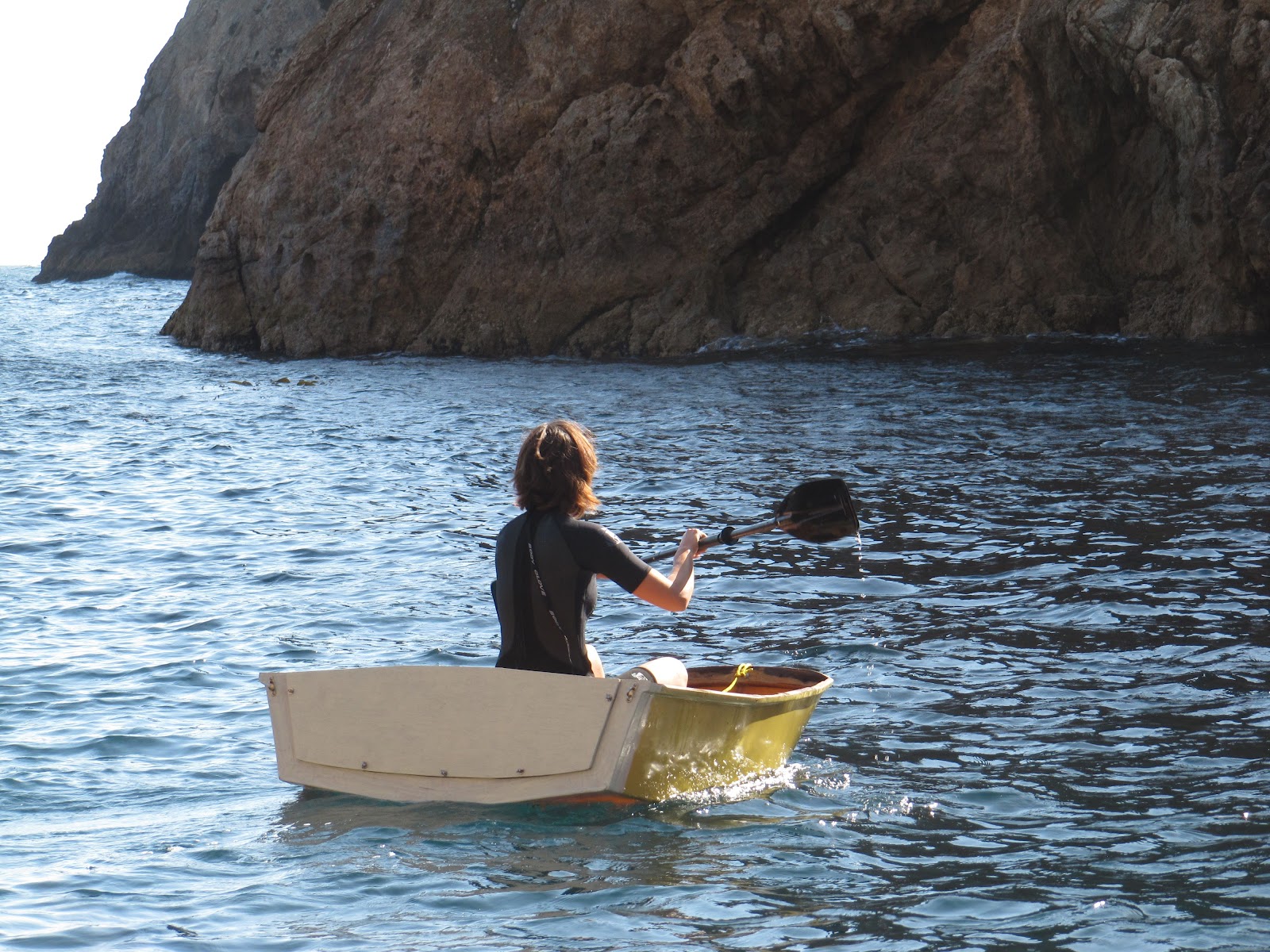
I've wanted a hard dinghy that's small enough to fit on Koan's foredeck, and big enough to carry one or both of us and the dog from the boat to shore when we're out at the islands. When someone posted a free Naples Sabot on craigslist, I jumped at the opportunity. The Sabot is 8 ft long, and we only have about 6 feet of length on the foredeck, before the dinghy starts to interfere with the anchor cleat. In addition, the cabin is in the way, and the dinghy can't lie flat. I didn't like the idea of it sitting on top of the cabin top, because it's difficult to stabilize it by tying it down, and it's also very high, with a lot of windage. So the obvious solution to all our problems was to shorten the dinghy and build a custom transom that fits around the cabin top. 

I used 3/8'' ACX plywood, which I screwed in at three places, and two layers of fiberglass tape. Then I painted everything, and made an overlapping transom piece that screws in with 5 bolts, tightening around a thin rubber strip to make it water tight. 

It seems to work!

Sunday, May 13, 2012

Wednesday, April 4, 2012

Time lapse videos from the trip

During our recent sailing trip to Santa Cruz Island we had the use of Dan's Hero HD camera with a waterproof enclosure, so we took some time lapse photography series. The settings were for 720p every 30 seconds, and I compiled them at 1 frame per second at lower resolution.

The first time lapse is of our first morning at anchor. We're having breakfast and doodling around. The water's too cold to go snorkeling, so we're kind of boat-bound. I think that in these circumstances the boat is very much like a super comfy portaledge.


The second time lapse is of us motoring towards our next anchorage that afternoon. The island is to our left and we're checking out all the cool caves we're motoring by. A bit after the battery ran out things got interesting, as the wind kicked up right on our nose.


The third is of us sailing away from the island the day after, but after all the excitement of putting away the anchors and sailing through the windiest bit is done for. At some point in this time lapse we shake out the reef in the sail, as the wind drops, then switch to motoring when the wind dies completely.


The final video is on that same leg, when the wind comes back up, from the opposite direction, when we're about 5 miles offshore of Santa Barbara. At this point we have water or some other kind of gunk on the camera's enclosure, so the view is a little blurry.


This was my first experiment with time lapse, and I had a lot of fun. It saves battery power compared to video (i.e. you can get a longer time lapse series than you can shoot continuous video on the same amount of battery power) and it's better at showing the motion of the boat through the seascape around it. Since the Hero is mounted on a fixed point in the boat you lose all sense of the boat's side-to-side motion, which is considerable, but you can get that back by focusing on any object on the boat that's hanging, e.g. the gloves or a mug on the lifelines, or a line off the spreaders in the first video. Of course, unlike in video, there is no sound. I could've stuck a sound track on these, but I wanted to try them out on you raw first. What do you think? What stands out? Does it look like what you thought things would look like on a small boat?

Tuesday, April 3, 2012

Gear abuse

Because this was the Origo stove's first trip, I wanted to have a backup stove in case that didn't work. Also I was imagining an outside stove and an inside stove situation, so that if we felt like hanging out in the cockpit we wouldn't have to, you know, commute five feet into the cabin to check if the water's boiling. I don't know, explain it however you like! I was just over-prepared, as usual.

So I brought along my beloved pocket rocket, plus a hanging kit for a jetboil that I found on sale at some point. The hanging kit doesn't work properly for the pocket rocket, but, well, we're equipped with all sorts of fun things on board, including fancy $10/roll Monel bailing wire, essentially. So I wired the stove to the hanging bracket. The plan was to suspend it from the backstay like so:

So I did and I put a pot of water on it, and lit it and let it do its thing, until the pot came crashing down, and when I looked up at the stove I found that the skeleton had bent.
I think the way I suspended it had the skeleton a bit too close to the flame, and as it warmed up it became softer and it eventually warped. The good news is that I'm so strrrrong that I was able to bend it all back into shape. For what? The next experiment in gear abuse, I'm sure.